22 terms from Google Ads and Meta, each explained in one sentence, with the formula and a number from an account we actually manage. And for each one: when the number helps you, and when it fools you.
 By Victor Skretteberg, Arcads · Published October 2, 202613 min read

cost ÷ clicksCPC ÷ conversion raterevenue ÷ costcost ÷ impressions × 1,000Example: NOK 18 ÷ 10.8% = NOK 166 per inquiry





Most of the terms below are links in the same chain. Some people see the ad (impressions), a share click (CTR), a share of those get in touch or buy (conversion rate), and a share of those become customers. The cost follows the chain:
| Link | Formula | Utvendig Renhold, search (1 July–30 Sept 2026) |
|---|---|---|
| Cost per click (CPC) | spend ÷ clicks | NOK 18 across 5,490 clicks |
| Conversion rate | conversions ÷ clicks | 10.8% |
| Cost per conversion (CPA) | CPC ÷ conversion rate | NOK 18 ÷ 0.108 ≈ NOK 166 |
The practical point: you can halve CPA in two ways, by halving the click price or by doubling the conversion rate. The click price is driven mostly by competitors. The conversion rate is driven by you, through the landing page, the form and what the ad promises. That is why we spend more time on pages than on bids. More in lead generation for service businesses.
Work backward: If a new customer can cost NOK 600 in ads and one in three leads becomes a customer, a lead can cost NOK 200. At NOK 18 per click, at least 9% of clicks then have to become leads (18 ÷ 200).
ROAS is the revenue your ads generate divided by what the ads cost.
Formula: ROAS = conversion value ÷ ad spend. 4x means NOK 4 in revenue per krone in ads.
From our accounts: QualiPet got 10.3x ROAS on Meta (Sept 2026).
When it matters: For online stores splitting budget across campaigns and products. When it fools you: ROAS measures revenue, not profit. If the store sends order value including Norway’s 25% VAT, ROAS looks 25% better than it is. And if tracking counts the same purchase twice, the number doubles. How high it needs to be is covered in what is a good ROAS.
POAS is the gross profit your ads generate divided by ad spend.
Formula: POAS = (revenue − cost of goods and other variable costs) ÷ ad spend. Above 1 means the ads earn more than they cost.
From our accounts: Mokki had 6.67x blended ROAS and 2.61 POAS in March 2026. The first number looks impressive, the second tells you what was actually left: NOK 2.61 in gross profit per krone of ads.
When it matters: When margins vary a lot between products. When it fools you: It is profit before fixed costs such as salaries and rent, and it is never better than the margins you feed it.
Breakeven ROAS is the ROAS at which your ads exactly break even.
Formula: breakeven ROAS = 1 ÷ gross margin. Worked example: a 25% margin gives a breakeven of 4x. If the value in the ad account includes VAT, multiply by 1.25.
When it matters: Always, before you set a ROAS target. When it fools you: When the margin is based on purchase price alone. Shipping, payment fees and returns should come off first, or breakeven is set too low.
CPA is what one conversion costs in ad spend.
Formula: CPA = ad spend ÷ number of conversions, or CPC ÷ conversion rate.
From our accounts: In QualiPet’s Google account, a purchase cost NOK 69 from search, NOK 202 from Performance Max and NOK 375 from Shopping (1 July–30 Sept 2026). Search includes brand searches, which pull the average down.
When it matters: When you know what a conversion can afford to cost. When it fools you: A “conversion” is whatever the account is set up to count. If it counts clicks on the phone number or visits to the contact page, CPA becomes low and meaningless. And CPA for a purchase says nothing about whether the customer was new.
CPL is what one inquiry costs in ad spend: a form, a call or a booking.
Formula: CPL = ad spend ÷ number of leads. It is CPA where the conversion is a lead.
From our accounts: Utvendig Renhold got 549 leads in 90 days (June–Sept 2026), at NOK 163 on average including brand searches. Across the nine regions, the price ranged from NOK 145 (Trondheim) to NOK 341 (Østfold) for the same service.
When it matters: For any business that lives on inquiries. When it fools you: A cheap lead is not a good lead. A form with just name and phone gives a low CPL and lots of people who never pick up. Figures from several industries are in what a lead costs in Norway.
CAC is what it costs to win one new customer, not one lead and not one purchase.
Formula: CAC = all costs of acquiring customers (ads, agency, sales time) ÷ number of new customers in the same period.
Worked example: If a lead costs NOK 163 and one in three leads becomes a customer, the ad cost per new customer is NOK 489. Add fees and the time it takes to follow up, and you have CAC.
When it matters: When comparing channels or judging whether growth pays off. When it fools you: CPA in the ad account also counts repeat purchases and people who searched for your name. It is almost always lower than real CAC.
LTV, or customer lifetime value, is what a customer is worth to you over the whole relationship.
Formula: LTV = average order × purchases per customer × gross margin. Worked example: an NOK 800 average order, four purchases and a 40% margin give NOK 1,280 in profit per customer.
When it matters: LTV sets how much you can afford to pay for the first purchase. If customers come back, the first order can lose money. The ratio LTV ÷ CAC tells you whether customer growth makes money. When it fools you: When LTV is calculated on revenue instead of profit, or rests on repeat purchases you hope for but have not yet seen in the numbers. A new business rarely has enough data to calculate it.
CPC is the average price you pay for one click on your ad.
Formula: CPC = ad spend ÷ number of clicks. On Google you pay per click in the auction, not per impression.
From our accounts (search, 1 July–30 Sept 2026): NOK 18 for roof and facade cleaning, NOK 55 for move-out cleaning in Oslo, NOK 6 for an online store selling dog treats. Keyword Planner estimates NOK 69–252 for a top-of-page click on “rørlegger oslo” (plumber Oslo, Oct 2026).
When it matters: When estimating budget before you start. When it fools you: A cheap click can produce an expensive customer. Badstugutta paid NOK 13 per search click, but 1.3% got in touch, so a lead cost NOK 975. For a high-priced product that can still pay off. The click price alone tells you nothing.
CPM is the price for 1,000 impressions of your ad.
Formula: CPM = ad spend ÷ impressions × 1,000. Worked example: NOK 3,000 for 50,000 impressions is a CPM of NOK 60.
When it matters: On Meta and Snapchat, where you effectively pay for impressions. If CPM rises while nothing else changes, your audience has become more expensive to reach, for example before Christmas. When it fools you: A low CPM is not a goal. Cheap impressions often come from placements where nobody buys. We steer on cost per lead or sale, and look at CPM only to understand why it changed.
CTR is the share of people who saw your ad and clicked on it.
Formula: CTR = clicks ÷ impressions × 100. Worked example: 40 clicks on 1,000 impressions is a 4% CTR.
When it matters: On search it tells you whether the ad answers what people searched for. In the feed it tells you whether the first seconds stop anyone. When it fools you: A high CTR with a low conversion rate often means the ad promises something the page doesn’t deliver. We don’t give a “good” CTR average, because the number varies too much between search, Shopping and feed for one figure to help you.
Want to see what we would do for you? Send us your website and get a free proposal for ads and a landing page.
Get the proposal →Conversion rate is the share of clicks that end in a conversion, such as a form, a booking or a purchase.
Formula: conversion rate = conversions ÷ clicks × 100.
From our accounts (Google Ads, search, 1 July–30 Sept 2026):
| Account | Conv. rate | Cost per click | Cost per conv. |
|---|---|---|---|
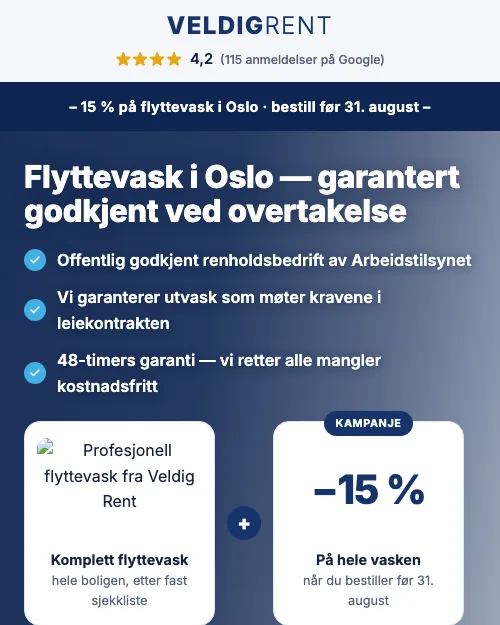
| Move-out cleaning, Oslo (Veldigrent) | 19.2% | NOK 55 | NOK 285 |
| Roof and facade cleaning (Utvendig Renhold) | 10.8% | NOK 18 | NOK 166 |
| Online store, dog treats (QualiPet) | 8.6% | NOK 6 | NOK 69 |
| Moving company (Raskflytting) | 8.5% | NOK 47 | NOK 549 |
| Saunas (Badstugutta) | 1.3% | NOK 13 | NOK 975 |
When it matters: It is the number you control most. When it fools you: Brand searches lift the average, and mobile and desktop are two different worlds. In the B2B leasing account we manage, desktop converted at 18.8% and mobile at 7.8% in the same period.
A conversion is the action the ad account is set up to count as a result.
For a service business it is typically a submitted form, a booking or a call lasting longer than 30–60 seconds. For an online store it is a purchase with an order value.
When it matters: Google and Meta optimise toward whatever you count. When it fools you: When the account counts page views, clicks on the phone number or the same purchase twice. In one of the online stores we manage, the Google account counts purchases twice, a known error, so we read that account against the store’s own numbers rather than Google’s.
A lead is an inquiry from someone considering a purchase: a submitted form, a call or a booking.
From our accounts: Utvendig Renhold got 142 leads in one week from Google Ads.
When it matters: Leads are what ads can deliver. Customers are what you live on. When it fools you: A click is not a lead, and a lead is not a customer. How many become customers depends heavily on how fast you reply. More in lead generation for service businesses.
Impression share is the share of the impressions you could have had on Google that you actually got.
Formula: impressions ÷ impressions you were eligible for. Google also shows how much you lost to budget and how much to rank (bid and quality).
When it matters: When you wonder whether more budget will bring more leads. If you lose a lot to budget and cost per lead is good, there is room for more. If you lose to rank, more money alone won’t help. When it fools you: 100% is rarely a goal, because the last impressions are the most expensive. Swings of a few percent from week to week are noise.
Quality Score is Google’s 1–10 rating of how well keyword, ad and landing page fit together.
It is built from three parts: expected CTR, how relevant the ad is to the search, and landing page experience.
From our accounts: A new landing page for business leasing delivered a 16.1% conversion rate and NOK 412 per lead (30 days to 13 Aug 2026). Even so, Google rated the landing page experience “below average” while the page sat on a subdomain. We moved it to the client’s own domain on 6 September 2026.
When it matters: Higher quality means a lower click price for the same position. When it fools you: It is a diagnosis, not a goal. A page that delivers cheap leads beats a page with a 10 that delivers nothing.
A brand search is a search for your company’s name.
From our accounts: The search “rask flytting” cost around NOK 44 per click in the moving company’s regular search campaign. It now sits in its own brand campaign with a cap of NOK 15 per click. For Utvendig Renhold, the average was NOK 163 per lead with brand searches and around NOK 188 without.
When it matters: Competitors can bid on your name, so a cheap brand campaign is often worth it. When it fools you: People searching for your name would mostly have found you anyway. Mixed in with everything else, they make your ads for new customers look better than they are.
Retargeting means showing ads to people who have already visited your website or seen your content.
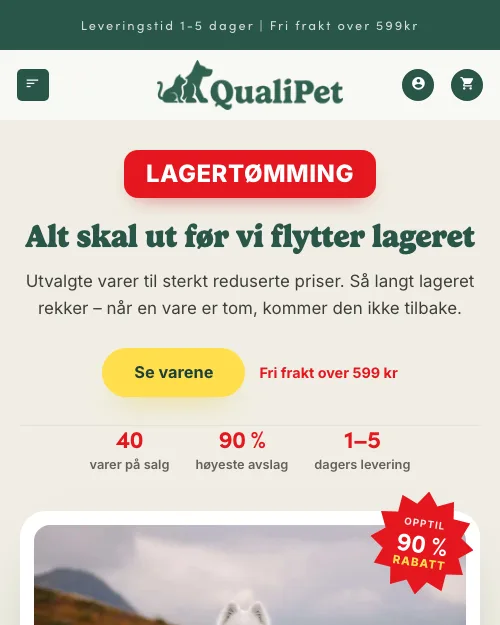
From our accounts (9 June–6 Sept 2026): A Performance Max campaign set up for retargeting delivered leads at NOK 116 for move-out cleaning in Oslo, against NOK 211 on search. For the moving company, the figures were NOK 310 and NOK 467.
When it matters: Most people don’t get in touch the first time. When it fools you: Retargeting tends to take credit for people who would have come back anyway. It can never grow beyond the traffic you already have.
Performance Max is Google’s campaign type that shows ads across Search, Shopping, YouTube, Gmail, Discover and the Display network from one campaign, run by Google’s machine learning.
From our accounts: The move-out cleaning account’s PMax had a 3.9% conversion rate, NOK 5 per click and NOK 121 per conversion (1 July–30 Sept 2026). The retargeting campaign also showed ads in mobile games and in children’s videos on YouTube, so we check the placement report regularly.
When it matters: When tracking is right and there are enough conversions to learn from. When it fools you: PMax likes to pick up brand searches and people who have already visited the site, and then looks better than it is. More on Google’s AI campaigns in AI in marketing.
Shopping ads are product ads with an image, price and store name, pulled from your product feed in Google Merchant Center.
From our accounts (1 July–30 Sept 2026): In the QualiPet account, Shopping converted at 2.0% at NOK 375 per purchase, against 8.6% and NOK 69 on search. Search includes brand searches, so the comparison is skewed, but it shows why Shopping has to be judged on its own.
When it matters: For online stores with products people search for. When it fools you: The feed is the ad copy. Poor titles and images give expensive clicks whatever you bid. More in Google Shopping.
Attribution is the set of rules for which ad or channel gets credit for a sale or a lead.
Google Ads uses data-driven attribution by default inside its own account. Meta does the same in its own. Neither sees what the other did.
When it matters: When you move budget between channels. When it fools you: If a customer saw a Meta ad and later clicked on Google, both count the sale. Add up the channels and you get more sales than the store has. That is why we also measure MER.
MER is total revenue divided by total ad spend across all channels, measured in the online store or the accounts.
Formula: MER = total revenue ÷ total ad spend. Also called blended ROAS.
From our accounts: Leid.no ran at 4.73x across channels, with over NOK 100,000 a month in ads. Mokki was at 6.67x blended in March 2026.
When it matters: It is the number that can’t double count. When it fools you: MER includes sales that would have happened without ads, and it swings with seasons and campaigns. It tells you whether the whole works, not which channel did the job.
Conversion tracking is the code and setup that tells Google and Meta someone submitted a form, called or bought.
On Meta it is the pixel, often together with the Conversions API, which sends the same events from the server. On Google it is the Google tag and conversion actions, often alongside GA4.
From our accounts: When we started with Leid.no, tracking counted far more purchases than actually happened. That is why we set up tracking before spending a single krone on ads for a new client.
When it matters: Always. Every number above depends on it. When it fools you: When nobody has checked it. Place a test order or send a test form, and check that it shows up once, with the right value, in both accounts.
Would you rather we looked at your numbers? We take a share of what we earn you, not a fixed monthly fee. If you don’t earn more, you pay us nothing. For it to work for both sides, the ads need to generate enough for our share to be around NOK 20–30,000 a month. That is why we work with established businesses with at least NOK 30,000 a month in ad budget. How it is calculated.
The numbers come from our clients' own ad accounts.

profit year over year
Google Ads in Norway, Germany and DenmarkRead the case
ROAS
From broken tracking to profitable scalingRead the case
ROAS
Meta ads, September 2026Read the case
leads in 90 days
NOK 163 per lead incl. branded searchesRead the caseBe next on the list. The proposal is free and comes with no commitment.
Campaigns, ads, landing pages and tracking. One partner, no middlemen, no freelancers to wait on.
Campaign pages for your online store and landing pages with forms for leads. Built for ad traffic, not for your website menu, and they're yours.


UGC video, statics and motion graphics. 10+ new ones a week, all made in-house.
Search, Shopping and Performance Max. Structure, negative keywords and scaling based on profitability, not clicks.
Google Ads agencyFacebook, Instagram and Snapchat, with ongoing testing of new ads every week.
Meta Ads agencyGoogle Ads, Meta Pixel and GA4 set up correctly first. Then you see every sale and every lead yourself.
Numbers you understand, every Monday. What was done, what it brought in, what we're doing next week.
You see the proposal before you've paid a single krone.
Arcads is a Norwegian performance marketing agency in Skien that runs Google Ads and Meta Ads and makes the ads itself, for clients all over Norway. We mostly work with online stores and service businesses that live on leads, often with multiple locations.
Victor is the one you meet on the first call. He builds your Google account and digs into the numbers. You get a report every Monday.
Victor on LinkedInJona makes the ads you see on this page. Videos, statics and concepts. 10+ new ones a week don't make themselves.
Jona on LinkedInWe got tired of agencies that invoice whether it works or not, so we built our own. No middlemen, no salespeople. You get us.
One partner instead of a slow agency, a freelancer you have to chase, or yet another evening in front of the ad account yourself.
| Arcads | Typical agency | Freelancer | Do it yourself | |
|---|---|---|---|---|
| Payment | 100% performance-based | Fixed fee | Hourly rate | Your own time |
| New ads | 10+ a week | A few a month | One at a time | When you find the time |
| Landing pages | Included, made by us | Extra invoice | Rarely | Your website |
| Reporting | Every Monday, numbers you understand | Quarterly report | None | You make it yourself |
| Who you talk to | Victor and Jona | Account manager | One person | No one |
| Lock-in | None | Often 6-12 months | None | None |
| Ownership | The accounts are yours | Varies | Varies | Yours |
Send us your website. You'll get a proposal for ads and a landing page by email within a couple of days.
Victor and Jona reply personally.The proposal is on its way within a couple of days. If it's urgent, email victor@arcads.no.